The Rivers of the Barwon / Barre Warre Yulluk Annual Reports provide an update on progress towards delivering the 7 Directions and 30 Actions that make up the Action Plan. These reports are a Victorian Government commitment to update the community annually on implementation of the 5-year Action Plan.
The Eastern Maar and Wadawurrung peoples have cared for this Country and its integrated waterways for millennia. The Action Plan recognises the waterways as living and integrated natural entities, and the unique role that Traditional Owners have as knowledge holders and custodians to be a voice of these living entities.
A new community-led approach, the Action Plan is guided by a 50-year Community Vision. The vision encourages agencies and community to walk together with the Traditional Owners of Barre Warre Yulluk.
By bringing everyone throughout the region together, we move closer to realising the Rivers of the Barwon community vision and delivering the beneficial outcomes we are collectively seeking for the health of our waterways.
How the 5-Year Action Plan builds on the vision for the Rivers of the Barwon / Barre Warre Yulluk
How the 5-Year Action Plan builds on the vision for the Rivers of the Barwon / Barre Warre Yulluk
Water actions
Shorter-term actions (2022 to 2023)
Actions address waterway health and amenity, and Traditional Owner involvement in waterway management.
Longer term actions (2022 to 2026)
Necessary changes to institutional arrangements and legislation
Further action to address water health and amenity
Land use planning actions
Actions address stronger land use planning development controls
Standards to guard against inapproriate development
Legacy outcomes
Waterways managed as living entities
Traditional Owners', their voices, and their values embedded in decision-making
Protection of waterway environment values
Increased community connection
Waterway amenity meets community expectations
Better land use planned integration in waterway management
50-year community vision: guides policy makers, waterway and land managers and the community
How the 5-Year Action Plan builds on the vision for the Rivers of the Barwon / Barre Warre Yulluk
Progress update for 2025
During 2025, DEECA undertook engagement with Traditional Owner groups across Victoria on Outcome 1 of Water is Life, Traditional Owner Access to Water Roadmap, seeking input into the development of a law proposal to recognise all Victorian waterways as living. A 'What We Heard' Report summarising the findings of the 2025 engagement was provided to participating Traditional Owner groups in December 2025.
Following review and consultation, the Government approved and formally implemented planning scheme amendment VC278 in late 2025. This amendment makes existing planning controls for the Rivers of the Barwon (Barre Warre Yulluk) permanent. See Direction 3.
Three high-priority projects identified in the Kitjarra-dja-bul Bullarto langi-ut Masterplan continued to progress in 2025. Project partners continue to identify funding opportunities for the remaining Tranche 1 projects. Wadawurrung Traditional Owners Aboriginal Corporation (WTOAC) provided important cultural input to a number of priority Masterplan projects. See Action 4.5.
The City of Greater Geelong (CoGG) has developed a draft stormwater offsets scheme, in accordance with the stormwater offsets framework developed by DEECA in 2021. Further consultation on pricing is now required, with the outcome to go to Council for consideration. See Action 6.2.
Coordinated advocacy by partner organisations, led by Golden Plains Shire Council, has increased stormwater management standards in the draft Bannockburn South East Precinct Structure Plan (PSP), which is awaiting approval. See Action 6.3.
The Action Plan outlines 7 Directions and 30 Actions that aim to deliver results across a 5-year period. All short-term actions have now been completed. Most of these were reported on in the 2022 to 2024 annual reports.
Overall action status
Delivered/ superseded*: 19
Ongoing: 6
In Progress: 4
In Planning: 1
*includes items that have been superseded as they are considered to have been delivered
Direction 1: Recognise the Rivers of the Barwon / Barre Warre Yulluk as living and integrated natural entities, and the Traditional Owners as their voice
Delivered / superseded: 5 Ongoing: 1 In Progress: 0 In Planning: 0
Direction 2: Embed Traditional Owners’ values in planning and decision-making for waterways
Delivered / superseded: 2 Ongoing: 1 In Progress: 1 In Planning: 1
Direction 3: Strengthen planning policy and controls for waterways
Delivered / superseded: 6 Ongoing: 0 In Progress: 0 In Planning: 0
Direction 4: Improve waterway amenity to meet community expectations
Delivered / superseded: 4 Ongoing: 1 In Progress: 1 In Planning: 0
Direction 5: Identify opportunities to meet environmental and cultural water needs
Delivered / superseded: 1 Ongoing: 0 In Progress: 1 In Planning: 0
Direction 6: Strengthen stormwater management to build resilience
Delivered / superseded: 1 Ongoing: 2 In Progress: 0 In Planning: 0
Direction 7: Ensure accountability and transparency for Action Plan delivery
Delivered / superseded: 0 Ongoing: 1 In Progress: 1 In Planning: 0
Looking ahead
In 2026, the Rivers of the Barwon / Barre Warre Yulluk Action Plan enters the final year of its five-year implementation timeframe. Key priorities for 2026 include:
Following public consultation, DEECA will continue work to finalise the Third Victorian Waterway Management Strategy. The strategy includes an increased focus on urban waterways and their importance to communities, including amenity, health and environmental outcomes (see Action 4.6).
Corangamite Catchment Management Authority (CMA) will publish a draft of its new Regional Waterway Strategy and seek stakeholder and community feedback. The strategy has been guided by Eastern Maar and Wadawurrung Traditional Owners and their priorities for the waterways as living entities (Action 2.5).
Corangamite CMA and partners will finalise designs for the fishways on the Parwan / Barwon River at Buckley Falls and Moorabool Yaluk / Moorabool River at Batesford Weir, subject to the outcomes of hydraulic, heritage and cultural assessments (Action 4.5).
Project partners will complete plantings and works funded through the Green Links grants program. This includes the Bunanyung Landscape Alliance project, Urban Ripple: Restoring our Yarrowee Rivers and its little creeks, and a 69-hectare project in the Barwon River region being delivered by Corangamite CMA, the City of Greater Geelong, Deakin University, Barwon Water and Wadawurrung Traditional Owners Aboriginal Corporation.
With additional funding to support its coordination role, Corangamite CMA will commence new priority projects in collaboration with partners to implement Kitjarra-dja-bul Bullarto langi-ut. Wadawurrung Traditional Owners Aboriginal Corporation has also been funded to continue engaging in the Masterplan’s delivery.
Ongoing statewide engagement with Traditional Owners to develop and test legislative and policy approaches to recognise waterways as ‘living entities’ and their Traditional Owners as a unique ‘voice’ of those entities (Direction 1).
Case studies
Action 6.3: Central and Gippsland Region Sustainable Water Strategy stormwater investigations
DEECA, the City of Greater Geelong and Barwon Water established a collaborative project to review stormwater management arrangements in the Lower Barwon region.
The project aimed to:
understand current stormwater management arrangements across the region
identify gaps and areas of uncertainty in roles and responsibilities
assess alternative stormwater management models used elsewhere in Australia and identify options for further consideration.
The final report will identify practical options and further actions to improve stormwater management arrangements in the Lower Barwon.
In addition to this review, partners are prioritising funding, delivery and clear responsibilities for short-term stormwater volume management solutions in the Geelong and Bannockburn growth areas.
This work supports delivery of Action 3-14 of the Central and Gippsland Region Sustainable Water Strategy.
Action 4.5: Support for Kitjarra-dja-bul Bullarto langi-ut priority projects
Corangamite Catchment Management Authority (CMA) is planning, designing and constructing fishways on the Barwon and Moorabool rivers to address barriers to fish migration.
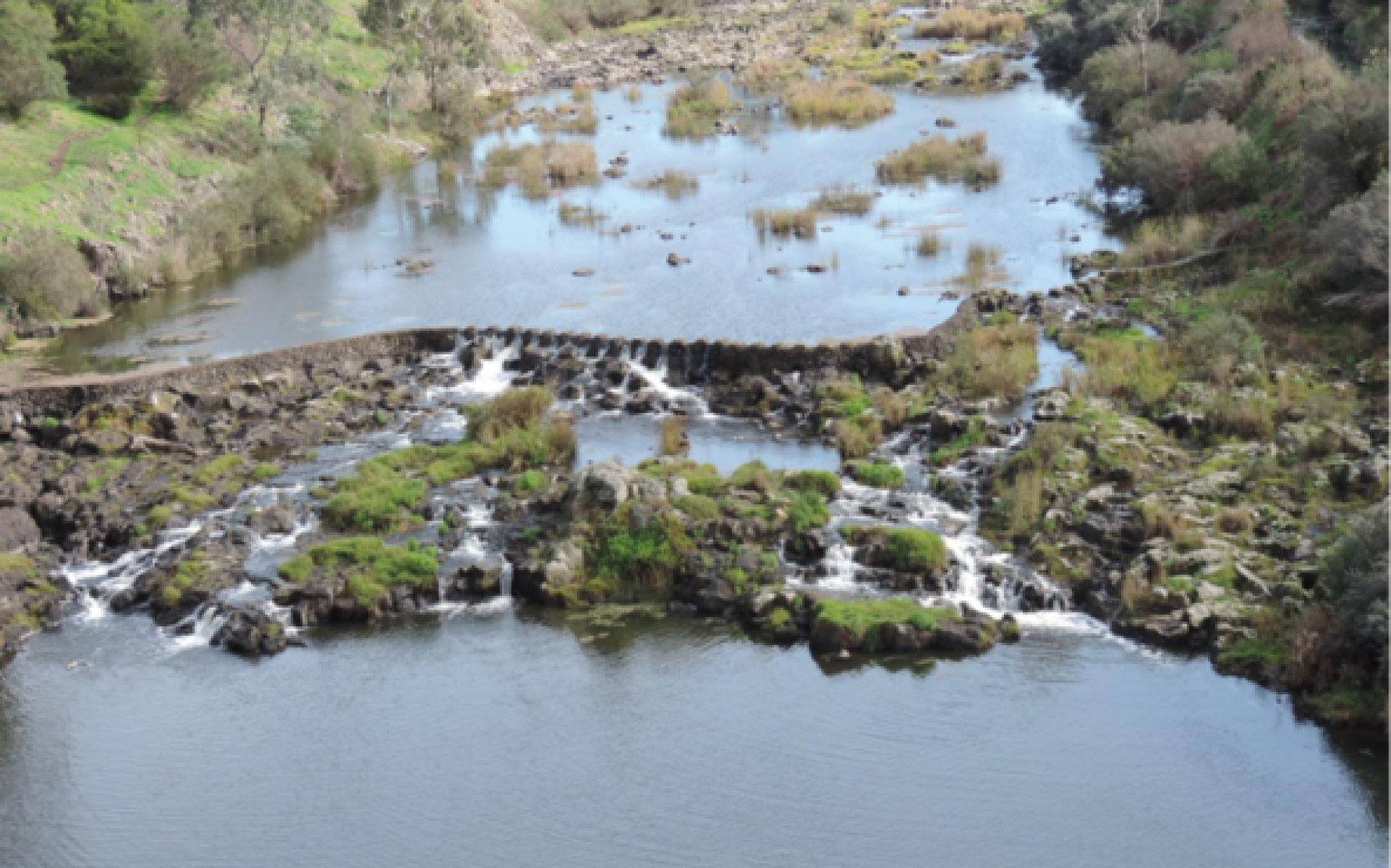
The project received $1.67 million through the Australian Government’s Urban Rivers and Catchments Program to support the design and construction of fishways at Buckley Falls (Figure 1) and at a downstream rock pool on the Lower Barwon River. The funding will also support removal of the Batesford Weir on the Lower Moorabool River and the design of a further fishway at Baum’s Weir on the Barwon River.
The project will improve passage for migratory fish species, benefiting aquatic health, habitat and food chains. Restoring fish passage at these barriers is expected to benefit at least 15 native fish species, including the vulnerable Australian Grayling (Prototroctes maraena).
The Corangamite CMA is also collaborating with Wadawurrung Traditional Owners to progress storytelling, interpretive signage, cultural aquaculture and site renaming, supporting cultural, community and environmental outcomes.
Buckley's Falls fish barrier
Source: Corangamite Catchment Management Authority
Previous annual reports
The 2024 Annual Report outlines actions delivered and progressed in the third year of the action plan, including:
The 10-year implementation phase of the Kitjarra-dja-bul Bullarto langi-ut Masterplan began, delivering new recreational and amenity benefits to the community.
Funding was provided for a coordinator role at the Corangamite CMA to support master plan implementation. Additional funding was also allocated to the Wadawurrung Traditional Owner Aboriginal Corporation, ensuring they are resourced to support and participate in implementation activities over this period, consistent with Action 4.5.
The West Fyans Street boat ramp upgrade was completed and officially opened by the Corangamite CMA. This upgrade provides safer and improved river access for unpowered watercraft.
Support for integrated water management planning in Bannockburn and Geelong growth areas was ongoing. The work is particularly focused on investigating management options for stormwater, consistent with Direction 6.
The 2023 Annual Report captures and reflects actions delivered and progressed in the second year of the action plan.
In 2023, the Rivers of the Barwon /Barre Warre Yulluk Action Plan supported:
Finalisation of the Kitjarra-dja-bul Bullarto langi-ut Masterplan and support to progress 3 high priority projects that aim to deliver new recreational and amenity benefits to the community.
The development of the Moorabool River Reserve Masterplan 2023-2033, which was adopted by the Golden Plains Shire Council in 2023. The Masterplan aligns with current Government policy on the protection and health of the Moorabool Yaluk/Moorabool River under the Corangamite Waterway Strategy and Rivers of the Barwon / Barre Warre Yulluk Action Plan.
Engagement with Wadawurrung Traditional Owners on the development of a discussion paper on ‘Waterways as living entities and Traditional Owners as their voice’.
The Department of Transport and Planning to continue progressing the urban planning actions outlined in the Action Plan.
Released in April 2023, the 2022 Annual Report reflects the first year of implementation of the Action Plan.
In 2022, the Action Plan delivered:
Stronger planning controls and policy to protect significant rivers and creeks in the Barwon Catchment from the impacts of urban development.
Collaboration to improve the understanding of roles and responsibilities of stormwater management and planning in Geelong.
Mapping of waterway amenity and environmental values incorporated into the development of the Kitjarra-dja-bul Bullarto langi-ut, the Barwon River Parklands Masterplan.
Stronger partnerships with Eastern Maar and Wadawurrung Traditional Owners, including supporting participation in the planning and ongoing implementation of the Corangamite Regional Catchment Strategy.