The Waterways of the West Annual Report updates the community on the progress towards delivering our waterways action plan.
On this page:
The Victorian Government released the Waterways of the West Action Plan in late 2021 to ensure Melbourne’s western waterways are healthy and thriving for future generations.
The Waterways of the West Annual Report updates the community on progress towards delivering the 9 Directions and 40 Actions that make up the Action Plan. These reports deliver on the Victorian Government’s commitment to update the community annually on implementation of the 5-year Action Plan.
The Bunurong, Wadawurrung and Wurundjeri Woi Wurrung peoples have cared for this Country and its integrated waterways for millennia. The Action Plan recognises the waterways of the west as living and integrated natural entities, and Traditional Owners as having a unique role as a voice of the living entities on their Country.
A new community-led approach, the Action Plan is guided by a 50-year Waterways of the West Community Vision. The vision encourages agencies and community to walk together with the Traditional Owners of Melbourne’s West.
By bringing everyone throughout the region together, we move closer to realising the Waterways of the West community vision and delivering the beneficial outcomes we are collectively seeking for the health of our waterways.
How the 5-year action plan builds on the vision for the Waterways of the West
Figure 1: Waterways of the West implementation framework
How the 5-year action plan builds on the vision for the Waterways of the West
50-year Community vision
Guides policy makers, waterway and land managers and the community.
Shorter-term actions (2022-23)
Water actions
Actions address waterway health and amenity, and Traditional Owner involvement in waterway management
Land use planning actions
Actions address stronger land use planning and development controls
Standards to guard against inappropriate developent
Longer-term actions (2022-2026)
Water actions
Necessary changes to legislation and institutional arrangements
Further actions to address waterways health and amenity
Land use planning actions
Strengthen planning provisions for waterways
Embed the role of Traditional Owners in planning and management
Legacy outcomes
Waterways managed as living entities
Traditional Owners', their voices, and their values embedded in decision-making
Protection of waterway environemtn values
Increased community connection
Waterway amenity meets community expectations
Better land use planning integration in waterway management
How the 5-year action plan builds on the vision for the Waterways of the West
Figure 1: Waterways of the West implementation framework
Overview of progress in 2025
Highlights include:
In late 2025, the Government approved Planning Scheme Amendment VC278, which put in place planning controls to protect Skeleton, Stony and Jacksons Creeks (among other waterways), and made existing planning controls for Waterways of the West permanent. See Actions 3.4 and 3.5 in the Waterways of the West Action Plan.
DEECA undertook engagement with Traditional Owner groups across Victoria on Outcome 1 of Water is Life, Traditional Owner Access to Water Roadmap, seeking input into the development of a law proposal to recognise all Victorian waterways as living. A 'What We Heard' Report summarising the findings of the engagement was provided to participating Traditional Owner groups in December 2025.
City of Wyndham completed the Davis Creek feasibility study. The study, funded by DEECA, gathered information and assessed the feasibility of a new pedestrian bridge, river access, and improved local play at the Davis Creek and Wirribi Yaluk/Werribee River confluence in Tarneit. The location was identified as a priority due to its proximity with the future Werribee Township Regional Park. This will be an ongoing project driven by the Lower Werribee Waterway Amenity Action Plan.
Melbourne Water, funded by DEECA, is working to develop a new waterway collaboration, and strategic plan for the Maribyrnong River, its tributaries and catchment. This work drives co-delivery of outcomes for the Maribyrnong as guided by the 50-year Community Vision for the Waterways of the West, as well as supporting key actions and outcomes under the Healthy Waterways and Port Phillip and Western Port Regional Catchment Strategies. Gaining the self-determined participation of Traditional Owners Wurundjeri Woi-wurrung Cultural Heritage Aboriginal Corporation and buy-in from the catchment’s community and agency stakeholders has been a focus of the initial stages of implementation. See Directions 2, 4, and 8.
The Adapt West project completed and released a series of reports to support project planning and delivery. A Stage 2 Summary Report highlighted outcomes from three studies investigating the community, social, ecological, and cultural values of Port Phillip Bay’s western shoreline. It also outlined the project’s key adaption objectives and strategic vision. An assessment of coastal hazard exposure (Stage 3) was also completed with a summary of the work published. See Action 5.3.
Work started on a new pollution prevention program that focuses on industrial areas in the Maribyrnong catchment. The program will strengthen pollution monitoring, grow analytical capacity, and support businesses to manage their environmental risk. It will also support aligned communication to businesses and the community about the importance of protecting the Waterways of the West from pollution. See Action 7.2.
For more detailed information on delivery of actions in the Waterways of the West Action Plan, please see the 2025 annual report:
The Action Plan outlines 9 Directions and 40 Actions that aim to deliver results across a 5-year period. Most short-term actions were delivered and reported on in the 2022 to 2024 annual reports.
Table 1: Status of actions across Action Plan directions
Direction
Delivered/ superseded actions
Ongoing actions
Actions in progress
Actions in planning
Direction 1: Recognise the Waterways of the West as living and integrated natural entities and the Traditional Owners as the 'voice of these living entities'
5*
1
0
0
Direction 2: Embed Traditional Owners' values in planning and decision-making for waterways
2
2
1
2
Direction 3: Strengthen planning policy and controls for waterways
5
0
0
0
Direction 4: Improve waterway amenity to meet community expectations
2
1
2
0
Direction 5: Better protection of the region's wetland values
2
0
1
1
Direction 6: Identify opportunities to meet environmental and cultural water needs
1
0
1
0
Direction 7: Protect the Waterways of the West from pollution
1
0
2
0
Direction 8: Increase community connection, education and participation
4
0
1
0
Direction 9: Ensure accountability and transparency for Action Plan delivery
0
1
2
0
Total
22
5
10
3
* includes items that have been superseded as they are considered to have been delivered
Looking ahead
The Waterways of the West Action Plan is entering the final year of its five-year implementation timeframe in 2026. Some actions for the year ahead include:
Following public consultation, DEECA will continue work to finalise the Third Victorian Waterway Management Strategy. The strategy includes an increased focus on urban waterways and their importance for community including amenity, health and environmental outcomes (Direction 4).
Melbourne Water will continue to lead the Maribyrnong Collaboration in 2026, working with Traditional Owners, agencies and community stakeholders to support coordinated planning for the Maribyrnong River, its tributaries and catchment, including preparation of a strategic plan for the waterway corridor.
7 Green Links grant projects in the Waterways of the West area are concluding, with final plantings and maintenance activities underway. City of Wyndham and the Werribee River Association will be adding 25,000 new plants along the Lower Wirribi Yaluk/Werribee River, while projects along the Maribyrnong River and Steele, Stony, Kororoit and Moonee Ponds Creeks will collectively deliver over 40 hectares of works along inner west waterways for both wildlife and community benefit.
Development of a Coastal Hazard Adaptation and Resilience Plan for the coastline between Hobsons Bay and Geelong as part of the Adapt West project. The plan will identify adaptation pathways, funding, roles and responsibilities, change management, triggers for review and a monitoring plan. In 2026, the project will be developing its priorities for adaptation and planning for Stage 5 of the project (Direction 5).
Launch of the implementation of the Pollution Prevention in Waterways of the West program that focuses on industrial areas in the Maribyrnong catchment. See Action 7.2.
Ongoing statewide engagement with Traditional Owners to develop and test legislative and policy approaches to recognise waterways as living entities and Traditional Owners as a unique voice of those entities (Water is Life: Traditional Owner Access to Water Roadmap, Outcome 1).
Case studies
Strengthening planning protections for Waterways of the West
Direction 3: Strengthen planning policy and controls for waterways
The Waterways of the West Action Plan includes several planning actions to strengthen planning controls and policies for waterway protection. In 2022, a planning scheme amendment introduced updates to State Planning Policy, established a new regional planning policy, and applied Significant Landscape Overlays to the Mirrangbamurn/Maribyrnong River, Moonee Moonee/Moonee Ponds Creek and Wirribi Yaluk/Werribee River. This delivered several short-term actions in the Action Plan, while longer-term actions to expand and finalise protections remained to be completed.
This staged approach meant that early policy reforms could be built on through more detailed strategic planning, allowing protections to be extended to additional waterways and existing interim controls to be reviewed before being made permanent.
In 2023, the Department of Transport and Planning’s Planning Controls for Waterways program undertook further strategic planning work for Cherry Creek, Emu Creek, Jacksons Creek (biik wurrdha), Kororoit Creek, Deep Creek, Skeleton Creek, Steele Creek and Stony Creek. This work supported the implementation of additional planning controls and delivered Action 3.2 of the Action Plan.
The Planning Controls for Waterways program also reviewed the existing planning controls for the Mirrangbamurn/Maribyrnong River, Moonee Moonee/Moonee Ponds Creek and Wirribi Yaluk/Werribee River. In 2025, Planning Scheme Amendment VC278 expanded these controls within and beyond the urban growth boundary and made the interim controls permanent. This delivered Actions 3.5 and 3.6 of the Action Plan.
Together, these changes strengthen the planning framework for Waterways of the West by extending protections to additional waterways and providing greater certainty for the long-term management of river and creek corridors across Melbourne’s west.
Community-led restoration along Kororoit Creek
Direction 8: Increase community connection, education and participation
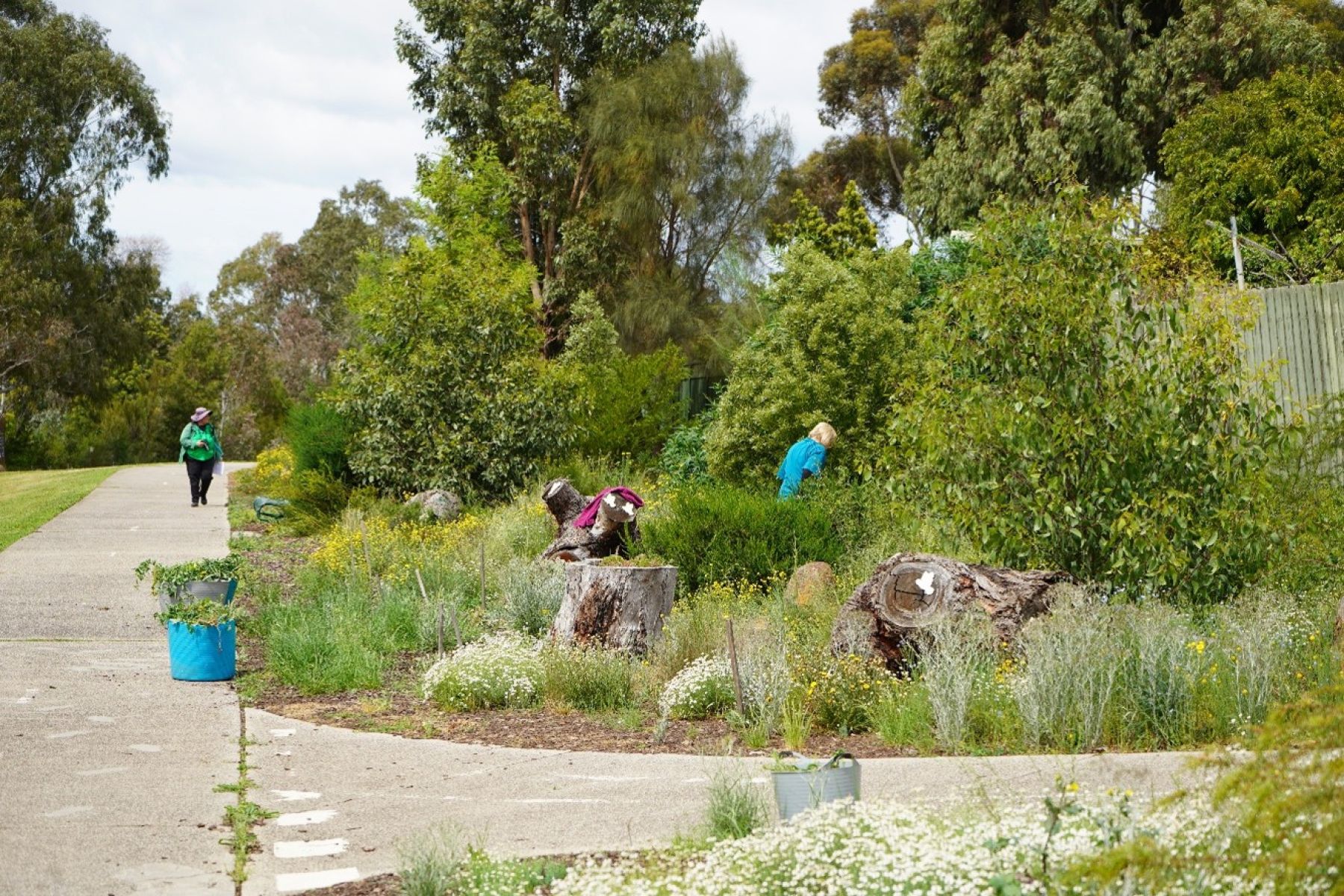
The Kororoit Creek: Slice of Haven in Suburbia Green Links project has led to habitat improvement and increased community connection along a valued section of Kororoit Creek in Sunshine West.
Delivered by the Friends of Kororoit Creek (FoKC), the project extends on an established regeneration area with 6,500 new plants, direct seeding, mulching and new habitat structures with the placement of rocks and logs. These works are creating valuable space for local wildlife to thrive, while also contributing to a cooler, more welcoming green haven for the community to enjoy.
The project was driven by the passion and commitment of the local community. Volunteers contributed many hours of collective effort, learning new skills and discovering more about the wildlife around them.
Brimbank City Council, also a Green Links grant recipient, partnered with FoKC to hold a beneficial pollinator survey and a ‘Moths After Dark’ moth and nocturnal insect survey. These activities were supported by expert entomologist Luis Mata. Hundreds of species were recorded the event, improving understanding of the range of local biodiversity along the creek. FoKC has also documented all the species found to date along the creek: https://www.inaturalist.org/projects/wildlife-of-kororoit-creek-friends-of-kororoit-creek-project
This project demonstrates the strength of collaboration and combining resources to achieve bigger results for nature and the community.
Fenceline planting along Kororoit Creek
Source: Friends of Kororoit Creek
Previous annual reports
The 2004 Annual Report outlines actions delivered and progress made across the third year of implementation of the Waterways of the West Action Plan, including:
Funding provided to support a First Nations resource to work with the Chain of Ponds Collaboration, to enhance cultural heritage values and Traditional Owner aspirations along Moonee Moonee/Moonee Ponds Creek.
The Maribyrnong River and Waterways Association continued to build on community and Traditional Owner connection with the Maribyrnong catchment. This included rolling out the Water Think Tank Series and a collaboration with the Wurundjeri Woi-wurrung Cultural Heritage Corporation, via the Yiagilang Ngarrngatj Research Unit, to explore the tangible and intangible cultural heritage of waterways in the Maribyrnong catchment.
The City of Wyndham, supported by a Department of Energy, Environment and Climate Action (DEECA) Iconic Urban Waterways grant, completed a concept design for improved landscape outcomes and on-water access at Bungies Hole, which is located in a bend of the Wirribi Yaluk/Werribee River behind Chirnside Park.
The Adapt West – Shaping our Shores project commenced and will deliver a Coastal Hazard Adaptation and Resilience Plan for the region, guided by the Port Phillip Bay Western Shoreline Regional and Strategic Partnership.
Funding was secured in the 2024-25 State Budget to progress pollution prevention initiatives.
You can read the full 2024 Annual Report for more information, including highlighted case studies of the work to date.
This annual report captures and reflects actions delivered and progressed in the second year of the action plan.
In 2023, the Waterways of the West Action Plan delivery milestones include:
A Waterways of the West Pollution Task Force recommendation report finalised and presented to DEECA.
Implementation of the Lower Werribee Waterway Amenity Action Plan underway including progress on the K Road Cliffs Masterplan, a Cultural Values Assessments undertaken by both Bunurong and Wadawurrung Traditional Owners, and the launch of the ‘Meet me by the River’ Guide.
Engagement with Bunurong, Wadawurrung and Wurundjeri Woi Wurrung Traditional Owners on the development of a discussion paper on ‘Waterways as living entities and Traditional Owners as their voice’.
The Department of Transport and Planning continuing to progress urban planning actions outlined in the Action Plan and ran a series of workshops with Local Government Authorities, Traditional Owners and community organisations.
You can read the full 2023 Annual Report for more information, including highlighted case studies of the work to date.