
Groundwater is a valuable natural resource for Victorian towns, regional economies, healthy environments and healthy Country for Traditional Owners. Under a changing climate, groundwater resources are more important than ever and face increasing pressure. Groundwater Management 2030 (GM2030) is the Victorian Water Sector’s commitment to ensure Groundwater Management in Victoria can adapt to these changing conditions.
Outcome 1 of GM2030 is 'an improved shared understanding of groundwater and its uses for evidence-based management'. The Sustainable Yield Assessment is a foundational component of this outcome and provides a new source of information that will support the next evolution in groundwater management, including the management of risks associated with climate change, now and into the future. It is the first time a statewide assessment of groundwater availability has been undertaken across all of Victoria.
The Sustainable Yield Assessment provides important information to water managers and users, improving transparency and a shared understanding. It will enable more informed and adaptive decision making to support sustainable groundwater use, where reliability of supply and groundwater-dependent ecosystems are protected.
It is a consistent way to assess the risk from licensed groundwater extraction across the state, which means we can focus our efforts where they matter most, checking whether current management is working and, where needed, exploring other ways to manage the risk.
The broad findings of the assessment have been summarised in the overview report.
Findings for each of the 66 Groundwater Management Units (GMUs) assessed in Victoria, as well as results for areas outside of the GMUs are provided in the Synthesis Results Report.
This report is a useful reference for the specifics of how groundwater availability may change and the key risks to the resource.
Sustainable Yield Asessment - Dashboard
If you are looking for information on a specific system, the Sustainable Yield Dashboard is an interactive map that can be used to view the Sustainable Yield and various other metrics such as the uncertainty range and average usage of the system.
The technical basis of the method, including how the sustainable yield volumes are estimated is outlined in the Methodology Report.
How will the Sustainable Yield Assessment be used?
The Sustainable Yield Assessment provides a new information source that will support the next evolution in groundwater management, including managing risks from climate change, now and into the future.
This is the first time DEECA has done an assessment of licensed groundwater extraction limits across all of Victoria and it has included assessment of over 1,000 groundwater systems.
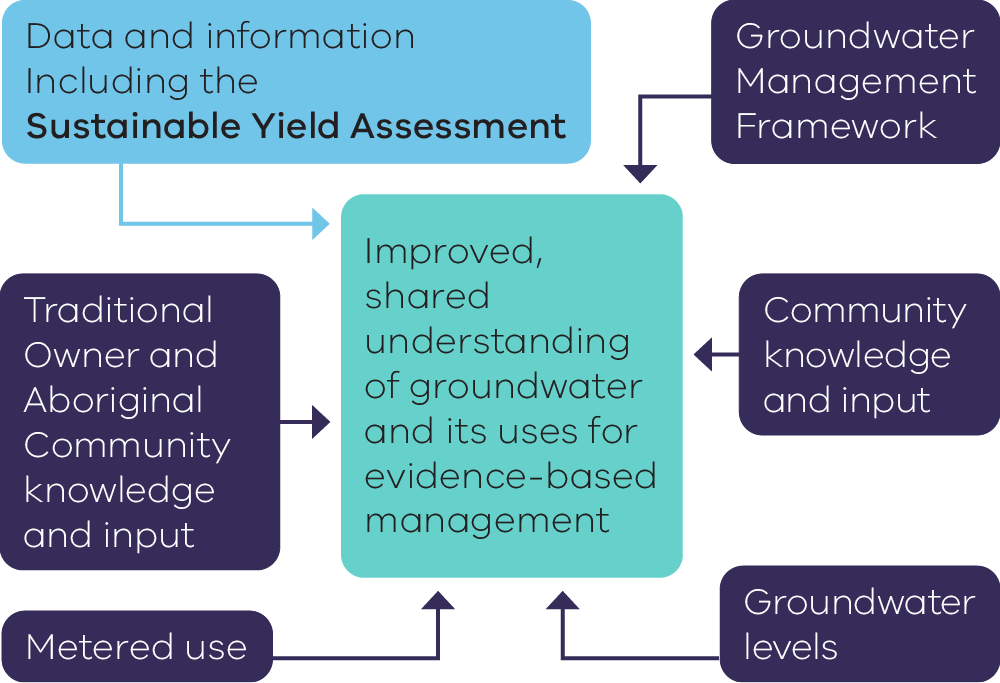
When we combine the Sustainable Yield Assessment with other sources of information, we improve our shared understanding of groundwater and how groundwater management can be improved (see diagram below).
As a technical assessment, the Sustainable Yield Assessment does not, in itself, result in any changes to groundwater management settings. It provides a consistent, evidence-based foundation to improve understanding of groundwater availability.
Existing entitlements remain secure, and any future management decisions would be considered taking into account local conditions, community input and existing management arrangements.
Most systems are being managed effectively for the current level of risk without the need for changes to local management. Rural Water Corporations already monitor groundwater condition, use a robust range of management tools and work closely with the community, especially in higher use systems, to manage risks.
However, we need to look at our tools for monitoring and managing future risks under our caps, before we see unacceptable levels of drawdown.
As a technical assessment, the Sustainable Yield Assessment does not, in itself, result in any changes to groundwater management settings. It provides a consistent, evidence-based foundation to improve understanding of groundwater availability.
Existing entitlements remain secure, and any future management decisions would be considered taking into account local conditions, community input and existing management arrangements.
Most systems are being managed effectively for the current level of risk without the need for changes to local management. Rural Water Corporations already monitor groundwater condition, use a robust range of management tools and work closely with the community, especially in higher use systems, to manage risks.
However, we need to look at our tools for monitoring and managing future risks under our caps, before we see unacceptable levels of drawdown.
Further information
For any additional queries or feedback on the Sustainable Yield Assessments and/or GM2030, please email GM.2030@deeca.vic.gov.au.
Page last updated: 13/10/26