On this page:

DEECA has implemented randomisation as the long-term approach for Goulburn-to- Murray and Barmah (with WaterNSW). It works as follows:

  1. Trade applications are submitted during a specified application window.
  2. Applications are assessed against eligibility requirements for the trade opening.
  3. Eligible applications are treated equally and entered into a randomisation process.
  4. The randomisation process determines the order in which applications will be processed.
  5. Applications are processed in the determined order until the available trade opportunity is exhausted.
  6. Applicants are notified of the outcome of their application following processing.

Applicants will be notified of the timing of the submission window in advance of every trade opening event. For information about dates, volumes, and times of the next trade openings go to Victorian Water Register news or contact waterregister.support@deeca.vic.gov.au.

Learn about the important information you need to know about the trade application submission process for the Barmah and Goulburn-to-Murray trade openings.

Step 1: What to do before the start of the trade application ‘submission window'.

Know your Allocation Account’s (ABA) tradable volume (less any pending trades) at the start of the submission window.

Make sure your application(s) will be eligible for inclusion in the randomisation process. A trade application submitted during the submission window is eligible for inclusion in the randomisation process only where the volume of that application, when added to the volume of all previously lodged (pending) applications for that seller account (ABA), does not exceed the volume available to trade that was recorded for that ABA at the beginning of the submission window.

In all instances, a trade application to ‘trade remaining balance’ is not eligible for inclusion in the randomisation process.

DEECA will assess applications using the documented New trade application procedure (PDF, 197.3 KB).

For any one seller ABA, the total volume submitted (whether singly or via multiple trade applications) for consideration into the randomisation process cannot exceed the volume of tradable allocation available in that ABA at the start of the submission window. In addition, and in all instances, a trade application to ‘trade remaining balance’ is not eligible for inclusion in the randomisation process

If you wish to submit multiple trade applications, the best way to determine if each application will be eligible is to:

  • Find the tradable balance of the seller ABA.
  • Deduct the seller volume pending (volume of all pending trade out applications) for that seller ABA.
  • Check that the resulting volume is greater than or equal to the volume of the proposed new trade application.

For clarity, please see the examples below:

Example 1

ABA000011 has a balance of 200 megalitres (ML) at the start of the submission window.

Trade application ALL020000 for 200 ML is submitted – this application is eligible for inclusion in the randomisation process.

Example 2

ABA000012 has a balance of 200 ML at the start of the submission window.

Trade application ALL020001 for 100 ML is submitted – this application is eligible for inclusion in the randomisation process.

Trade application ALL020002 for 100 ML is submitted – this application is eligible for inclusion in the randomisation process.

Trade application ALL020003 for 100 ML is submitted – this application is not eligible for inclusion in the randomisation process.

Example 3

ABA000013 has a balance of 200 ML at the start of the submission window.

Trade application ALL020004 for 100 ML is submitted – this application is eligible for inclusion in the randomisation process.

Trade application ALL020005 for 90 ML is submitted – this application is eligible for inclusion in the randomisation process.

Trade application ALL020006 to Trade Remaining Balance (TRB) is submitted – this application is not eligible for inclusion in the randomisation process.

Applications to ‘Trade Remaining Balance’ are no longer eligible for inclusion in the randomisation process.
For each ABA, find the tradable balance and deduct the seller volume pending (volume of all pending trade out applications) for that ABA.

This resulting volume is the volume available to trade at the start of the submission window.

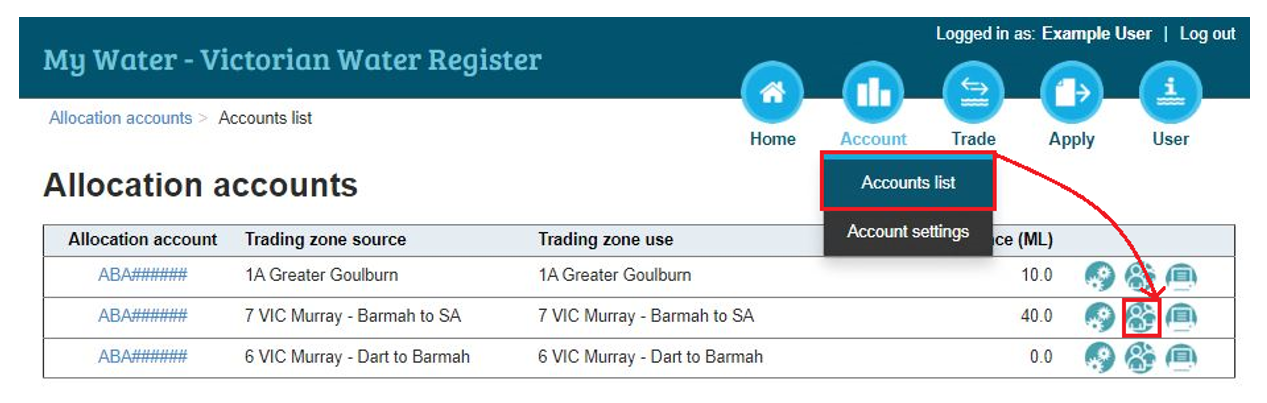
  • To find the tradable balance of an ABA in My Water, hover over 'Account' in the navigation bar, then click 'Accounts list' (see the illustrations below).
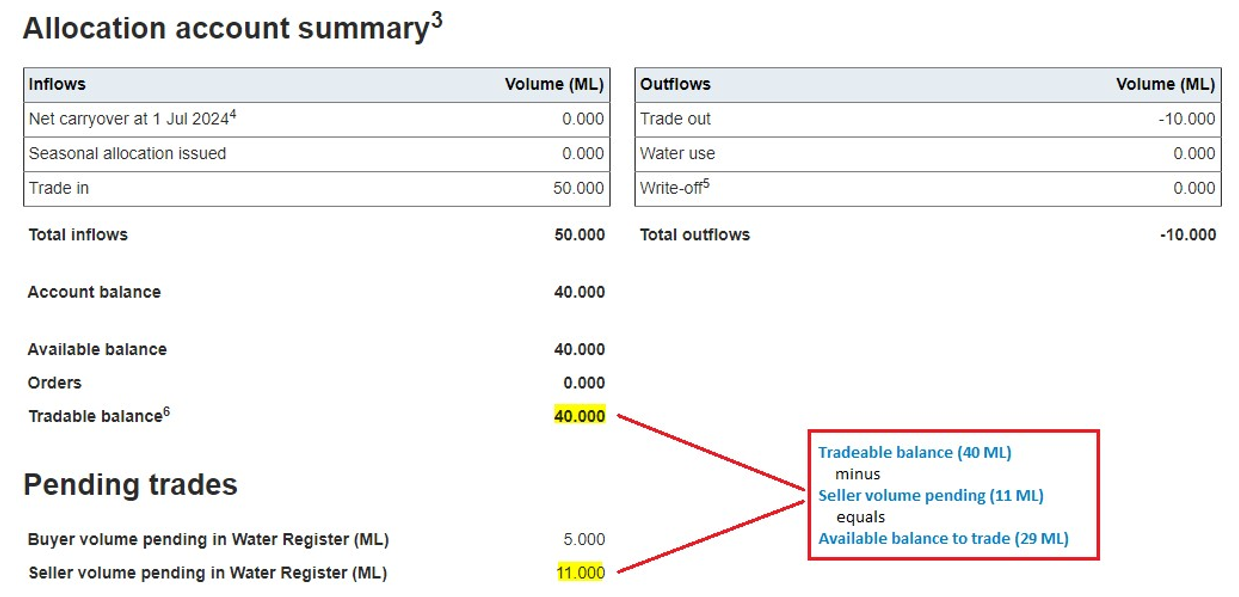
  • To find the seller volume pending on an ABA, click on the ‘Accounts details’ button for that ABA (represented in the illustration below by a blue circle with two people). Scroll down and note the ‘Seller volume pending in Water Register (ML)’.

Victorian Water Register screenshot of a user's allocation accounts.

The following illustration highlights where you can find trade volume information on the ‘Accounts Details’ page of your My Water account:

Victorian Water Register screenshot of a user's allocation account summary including inflows, outflows, available balance and tradeable balance.

Step 2: Submit your trade application(s) during the submission window

The submission window is a seven-hour window at the start of a scheduled trade opening. This is when trade applications for the Barmah and Goulburn-to-Murray trade opportunities can be lodged via My Water or the Broker Portal. Eligible applications submitted at any time during this window will be considered for the relevant trade opportunity.

Water market participants can submit applications at any time during this window – you are not required to submit your application as soon as the window opens. An application submitted at the start of the window will have the same chance of being approved as an application submitted at the end of the window. You are encouraged to lodge applications throughout the submission window.

All trade applications received during the submission window (including within zone trade applications) will be referred to manual processing during the submission window.

No changes have been made to the steps required to submit a trade application.

This means you will continue to use the My Water platform or Broker Portal to fill out, submit and pay for applications including all the relevant information normally required for a trade to be considered.

Yes.

There are no changes to the cost of submitting a trade application during the Barmah and Goulburn-to-Murray trade openings. As in previous manually-processed trade openings, fees are payable for all trade applications – whether they are rejected , approved, or refused – to cover the cost of processing.

No.

There is no limit on how many applications you can submit. But there are rules around which applications will be eligible for inclusion on the randomisation list.

If you wish to check that your trade applications have been lodged during the submission window navigate to ‘List of applications’ within the ‘Trade’ menu of My Water. This will take you to a page that lists allocation trade applications for your allocation accounts. Any trade submitted during the submission window will appear in this list .

If the status of the application(s) is recorded as ‘With water authority’ then the application has been submitted and will be checked for eligibility for inclusion in the randomisation process.
If your trade application is automatically refused – you may have submitted an application for a volume greater than the volume available to trade in your ABA at the time your application was submitted.

If you receive a notification of a refused trade and this is unexpected, please email waterregister.support@deeca.vic.gov.au during the submission window and include your phone number. We will contact you as soon as possible.

Step 3: Randomisation of trade applications to create a processing order

Barmah trade opening

Once DEECA and WaterNSW have (separately) completed the eligibility checks for Barmah trade applications they received during the submission window, each state’s eligible applications will be combined into one list.

Each application in this combined list will be assigned a random decimal number between 0 and 1. This will be done using the standard Excel Random function.

The list of eligible applications will then be sorted by the random decimal number, from smallest to largest. That order will become the processing order for Barmah trade applications.

The Barmah opening will follow the procedures as outlined in the Joint Protocol for Trade Application Submissions, Assessment and Processing (Victoria and NSW) (PDF, 540.9 KB).

Goulburn-to-Murray trade opening

Once DEECA has completed eligibility checks for all Goulburn-to-Murray trade applications received during the submission window, the eligible applications will be listed on an Excel spreadsheet.

Each application in this list will be assigned a random number between 0 and 100-million. This process in undertaken in the Victorian Water Register.

The list of eligible applications will then be sorted by the random number, from smallest to largest. That order will become the processing order for Goulburn-to-Murray trade applications.

To provide water market participants with confidence in the integrity of the process, the randomisation of eligible trade applications will be recorded and observed by the Australian Competition and Consumer Commission (ACCC) as an independent third party. The outcome of the randomisation step will be provided to the ACCC for record-keeping.

The ACCC will observe the execution of the randomisation process and attest that the process was undertaken correctly, with no interference observed. A copy of a written statement with their findings will be published once it becomes available.

The ACCC will undertake this role for the randomisation of Victorian and New South Wales’ eligible Barmah trade applications, and separately for the randomisation of eligible trade applications for the Goulburn-to-Murray trade opening.

Step 4: Processing of trade applications

Trade applications will be processed on the same day where possible.

Applications will be approved or refused based on standard rules for processing trade applications, with consideration of the remaining volume of trade opportunity and the volume available to trade in the seller ABA at the time of processing.

Note that the seller ABA balance could change between the submission window and the processing time due to usage posting or the approval of other trade applications after the submission window (e.g. an intravalley trade within zone 1A Goulburn).

As trade applications are processed, customers will be notified of their application outcome through standard avenues.

Email notification, in all instances, is sent only to the lodging party – the person that entered the trade application into My Water or into the Broker Portal. When a trade application is submitted by a broker, via the Broker Portal, then this broker will pass on the outcome notification to the seller and the buyer as required under the conditions of the Broker Agreement.

Tagged use is allowed when allocation trade is possible and restricted when allocation trade limits would prevent an allocation trade being approved, consistent with the Murray-Darling Basin Plan Water Trading Rules section 12.23.

Both allocation trade and use under tagged arrangements are subject to availability under the Goulburn-to-Murray trade rule.

How tagged use is managed has not changed, and tagged use will continue to reduce the available opportunity when it occurs.

Tagged use is people in the Murray using Goulburn water on their farms and is a legitimate but alternative way of moving water between systems.

Contact us

If you require further information or assistance, please contact the Victorian Water Register team at waterregister.support@deeca.vic.gov.au or the DEECA Customer Contact Centre on 13 61 86.

Page last updated: 19/11/26