This can include:
- initial fill, required at the start to fill a closed loop system
- ‘top-ups’ to offset water losses from evaporation, seepage and operational losses
- water to refresh the scheme, for example to improve water quality.

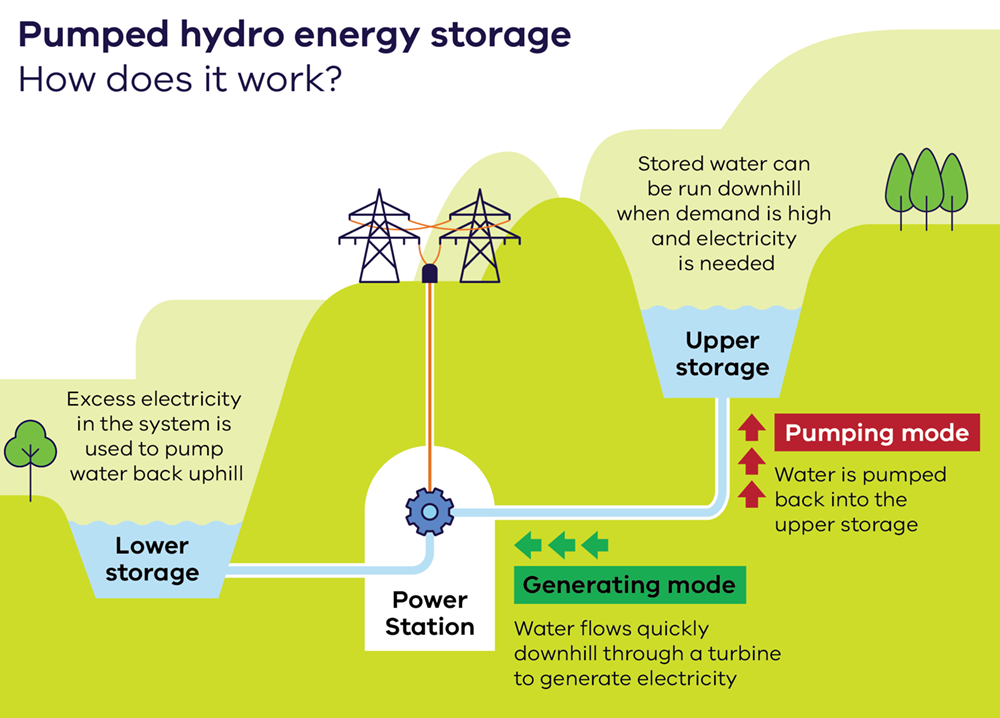
Pumped hydro energy storage (PHES) schemes can generate electricity by releasing water from an upper water storage to a lower water storage, passing water through turbines that generate power. Unlike conventional hydro power generation, PHES is an energy generation and storage system where water is cycled back and forth between the two water storages of different elevations.
Water held in the upper water storage of a PHES scheme acts like a big battery to switch on when it’s not windy or sunny. Water can be pumped to the upper storage when energy is cheap and plentiful (for example when wind or solar generation provides electricity excess to demand) and stored until electricity supply is constrained or in high demand, when water can be released to the lower storage to generate electricity.
PHES schemes can be configured in different ways, which influence their water needs and relationship with existing water infrastructure and systems, such as water storages. PHES schemes can be broadly separated into two categories: bluefield and greenfield sites:
Regardless of their type, all PHES schemes require an initial fill of water. The initial fill stage typically involves the highest water demand over the lifecycle of a PHES scheme and may take multiple years to fill.
Smaller volumes of water are required on an ongoing basis to ‘top-up’ the PHES storages to offset losses such as leakage or evaporation.
The below section summarises some key water-related aspects that a new PHES scheme should consider. For more information on how decisions are made around accessing and sharing water in Victoria, see water authorisations for pumped hydro energy storage.
This can include:
The availability of water for a PHES project will depend on a number of things, including where in Victoria the project is, the source of the water (manufactured water, water from a river or from a storage), and how many existing users already have rights to water in the system.
In looking to understand the availability of water for a PHES scheme, consider:
Project planning should consider the resilience of a PHES scheme during dry conditions to ensure sufficient water access in consecutive dry years.
Research suggests that due to climate change, there is likely to be reduced rainfall (particularly during the winter and spring period), and increased evaporation, leading to reduced annual average runoff. The latest Victorian Water and Climate Initiative findings can be explored more at Water and climate research.
While streamflow can be highly variable, it is expected that some aspects of this variability will increase in the future due to the influence of climate change.
In some instances, the operation of a PHES scheme may need to be altered to account for a water security or water quality risk. This may include:
In Victoria, dam owners are responsible for the safety of their dams. Dams must meet contemporary engineering and safety standards in their design, construction and operation.
Policy, guidance and oversight to dam owners for the safety of dams in Victoria is covered at Dam safety management. This includes safety management programs, monitoring and operational measures.
Operation of a PHES scheme can lead to rapid filling sequences as water is moved between storages. This can create additional stresses on the dam infrastructure beyond what is experienced at a conventional storage. They must therefore be designed and constructed to accommodate this purpose.
For more information on dam safety requirements, please refer to:
Constructing a dam on or near a waterway can cause significant impacts, including to the environment.
Project planning should consider potential adverse effects to the environment, waterways and aquifers, from construction and operational activities. Consideration of these potential impacts is part of the licence application for constructing and operating works on a waterway (section 68 of the Water Act).
Cultural heritage near waterways is a key project consideration. Technical guidelines for waterway management contains information on Traditional Owners regarding waterway management and approvals. Water is Life Roadmap and Working with Traditional Owners in water are 2 webpages that provide information about how government is partnering with Traditional Owners to manage waterways and catchments across the state.
Consideration also must be given to development in special water supply catchment areas, to minimise or avoid affecting water quality by contaminating runoff that flows into waterways.
The Environment Protection Authority Victoria (EPA) administers the Environment Protection Act 2017 and is responsible for controlling the environmental standards for wastewater discharge. If a PHES scheme intends to discharge effluent (e.g. refreshing the PHES storage(s) to improve water quality), an appropriate licence from the EPA may be required to authorise the discharge.
For more information visit the EPA website Guidance for risk assessment of wastewater discharges to surface waters.
Development of a bluefield PHES scheme should ensure operations are compatible with the intended and existing purpose of the storage and other uses of the infrastructure, including water supply, dam operation and dam safety obligations. Introducing a PHES scheme to an existing storage can potentially impact water quality and supply to existing entitlement holders.
Proponents of a bluefield PHES project may need to enter into an agreement with the owner of the existing storage. This agreement might cover operational, legal and financial matters such as:
In considering any potential agreement, the storage owner and operator of public water storages will need to consider how any proposal would impact their ability to maintain safe water storages, support waterway health and protect the reliability and quality of water supply to entitlement holders.
Large water storages across Victoria are typically owned and operated by Victorian water corporations. As well as operating key water infrastructure, water corporations also act on the Minister for Water’s behalf to make decisions about extracting and using water. Who manages our water? provides information on the urban and rural water corporations and the types of services they undertake.
For more on authorisations and Victorian legislative requirements, see water authorisations for pumped hydro energy storage.
PHES proponents are encouraged to reach out to the relevant water corporation to understand how their proposal could satisfy legislative requirements.
If you would like further information on how water-related considerations apply to your PHES project, please contact the Department of Energy, Environment and Climate Action.
Page last updated: 27/10/26